
Image

I was lucky enough to attend the 2026 National Indigenous Disaster Resilience (NIDR) Gathering, hosted by NIDR, the Jagun Alliance and the Gunaikurnai Land and Waters Aboriginal Corporation (GLaWAC) on their beautiful Country in May. Huge thanks and kudos to all three for hosting another amazing Gathering!
Three weeks on and heading into National Reconciliation week, with the theme of ’All in,’ I’m pausing to reflect on what all in means in the context of the rich insights from this year’s Gathering.
The Gathering team held an amazing space to reflect on how we can better support and recognise the resilience and leadership of First Nations Peoples who are often leading response and recovery in community without recognition or funding. The Gathering is a wonderful example of the power of a diversity of people together on Country, to form connections and the understanding this engenders. Conferences can have this impact, but holding them in air-conditioned conference centres can leave out a key partner from the conversation, Country. Sitting in the Wangun amphitheatre, we were surrounded by Country and connected to Country in a way that simply isn't possible in a dark indoor lecture hall (as much as this still on and part of Country).Truly, the Gathering goes all in to help people move outside their day to day to reflect on the possible.
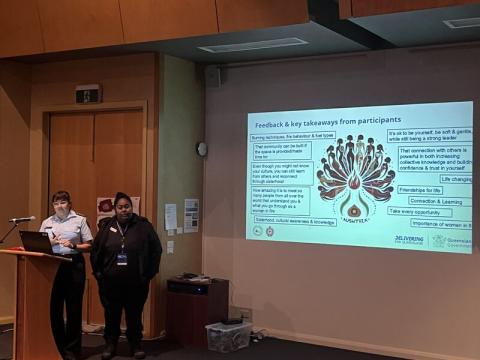
For me, I was proud to see how Natural Hazards Research Australia (the Centre) supported research contributing to this conversation, and could continue to do so into the future. The NIDR team held a great space to reflect on the emergent Indigenous Disaster Resilience Framework which is being co-designed as part of the Foundations in Indigenous Disaster Resilience project. Similarly, it was great to see the Australia Women-in-Fire Prescribed Fire Training Exchange (WTREX) team present, including findings from our First Nations women, cultural fire knowledge, wellbeing and memory project.
Image: Chloe Swiney (Queensland Fire Department) and Kylee Clubb (Queensland Fire Department and Gambir Yidinji Cultural Heritage and Protection Aboriginal Corporation)
There was also an amazing session where ranger groups and community leaders shared their experiences in helping their community respond to and recover from major floods. Across all the communities, the leadership First Nations rights-holders had played had been neither fully acknowledged nor supported. Research findings from our Connecting Indigenous people and the emergency management sector – effective partnerships project highlights how powerful and effective it can be if groups already in community and with the trust of communities, such as ranger groups are funded, equipped and trained. I think Coral Lever, CEO of First Nations Response, summarised this well when she said that trust sits within the community yet the power and funds sit elsewhere.
This resonates with the conversations with our amazing First Nations Pathways Working Group. The group has discussed extensively how First Nations Peoples are often framed as people in need of support in resilience and response without recognising the incredible knowledges and leadership of First Nations Peoples that could and should contribute to resilience decision-making. For the group the key is elevating First Nations Knowledges and sciences and recognising them as critical partners to western science in building the resilience of all Australians. This language is now a part of our draft research strategy and will inform the Centre’s work moving forward. In this context, ‘all in’ becomes ‘always in’. Always recognised, always included.
How can research help support the transfer of power to those who already carry trust in the community and are leading response in so many ways? We’ve already generated some great insights and evidence to help make the case. However, insight must be underpinned by genuine understanding so that when tangible steps are taken, they are grounded in the knowledges and aspirations of First Nations peoples. This is why events such as the Gathering are so important, because understanding is formed through relationship to place and to others. Shared meaning is only possible through genuine dialogue. In this sense ‘all in’ means ‘all together’.
More will be shared as we finalise our research strategy with the First Nations Pathways Working Group but if you want to know more have a look at this blog from our co-chairs of our amazing Pathways Working Group. You should also check out this great one pager with a statement from the Working Group on what the work means.
A huge thanks to them and all our First Nations colleagues and researchers for your wisdom, generosity and patience in helping the Centre understand how we can best support reconciliation.