
Image

Shaping the future of flood resilience, Floodplain Management Australia’s (FMA) 2026 National Conference brought together practitioners, policymakers and emergency management leaders to explore how Australia can strengthen flood risk management in an increasingly complex environment.
Natural Hazards Research Australia (the Centre) hosted a pre-conference workshop on the National Flood Intelligence Roadmap, led by the AFAC Flood and Severe Weather Intelligence Services Technical Group (FSWISTG). Facilitated by Liza Gelt and Rosie Tran (Collaborative Consulting Co), the workshop focused on the Roadmap Initiative: Setting the national direction.
The National Flood Intelligence Roadmap aims to deliver both short-term improvements and longer-term change. This includes building better data on what and who is at risk, improving how data is shared, clarifying who is responsible for what and strengthening partnerships with researchers.
The Centre workshop brought together cross-sector perspectives from around the country to examine flood intelligence as an interconnected system – spanning people, processes, systems, governance, partnerships and resources.
A key theme was the need to shift from simply describing floods to explaining what they mean for communities, infrastructure, essential services and emergency response. While traditional data like rainfall and river levels remain essential, there is growing demand for information that helps people understand impacts and how they evolve over time.
The session also highlighted that flood intelligence is a shared national responsibility, extending well beyond the emergency management sector. Effective flood intelligence relies on coordinated contributions from land-use planning, infrastructure and utilities, transport agencies, research organisations, local government and communities themselves.
As the roadmap progresses, the Centre will play a key role in supporting the research required to advance a more consistent and connected flood intelligence capability – ultimately improving outcomes for communities across Australia.
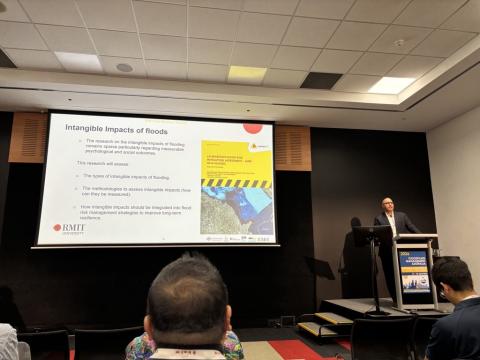
Image: A/Prof Tariq Maqsood
Centre research was shared throughout the conference with A/Prof Tariq Maqsood from RMIT University presenting findings from the Understanding intangible flood costs and impacts project – an important piece of work exploring the flood impacts that don’t always make it onto a balance sheet.
A/Prof Roslyn Prinsley at the Australian National University presented on her wider body of work researching nature-based solutions, drawing upon research findings from the Centre-support project Conserving and reconnecting floodplains to mitigate flood risk.
The Centre had a booth sharing our research and connecting with practitioners, researchers and policymakers across the sector.
Thank you to everyone who stopped by or joined us in the workshop. It’s always energising to be in a room full of people committed to building a more flood-resilient Australia.